Drive a Rally-Ready Porsche on Arctic Ice
A Journey into the Arctic with Kalmar Automotive
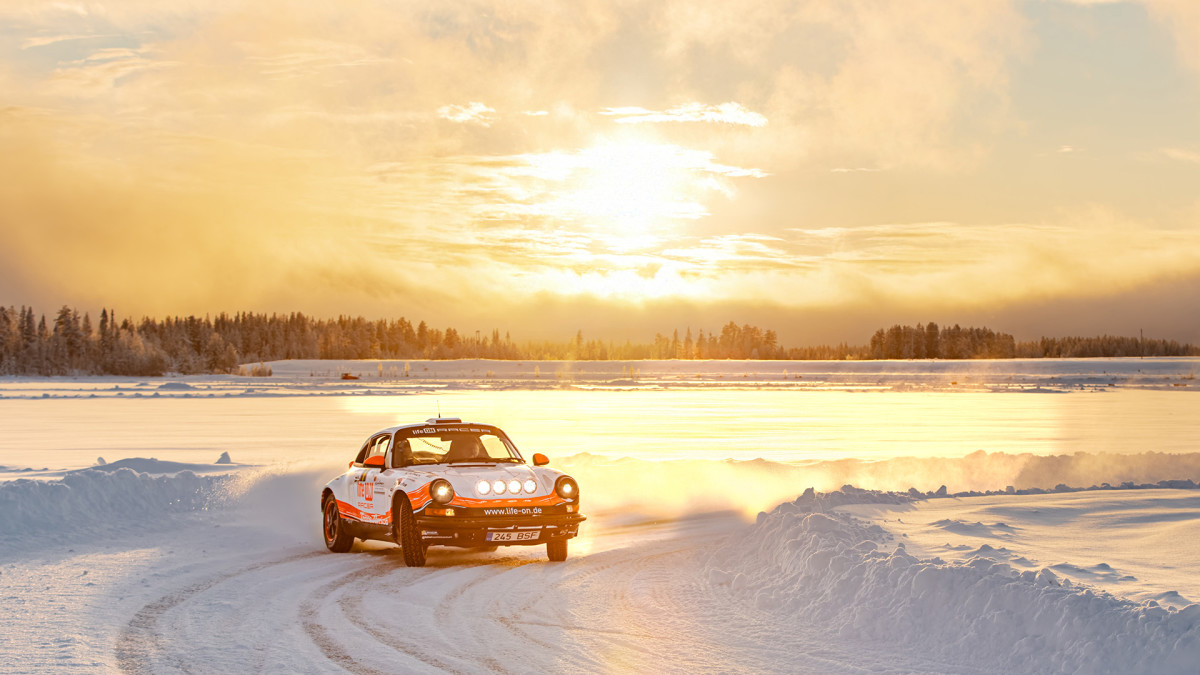
Driving a rally-prepped Porsche on a frozen lake north of the Arctic Circle sounds like a bucket-list fantasy—but after a full day behind the wheel in Finland, it turned into the single greatest driving experience of my life. From sliding classic 911s across ice to ripping through snow-covered rally stages, this wasn’t just another press trip—it was a masterclass in control, speed, and pure adrenaline.
I’ve driven everything from hypercars to desert racers, but nothing compares to what Kalmar Automotive is doing with its off-road Porsches. On a remote stretch of Arctic wilderness, I found the best driver’s car I’ve ever experienced—and the most unforgettable day I’ve ever had behind the wheel.
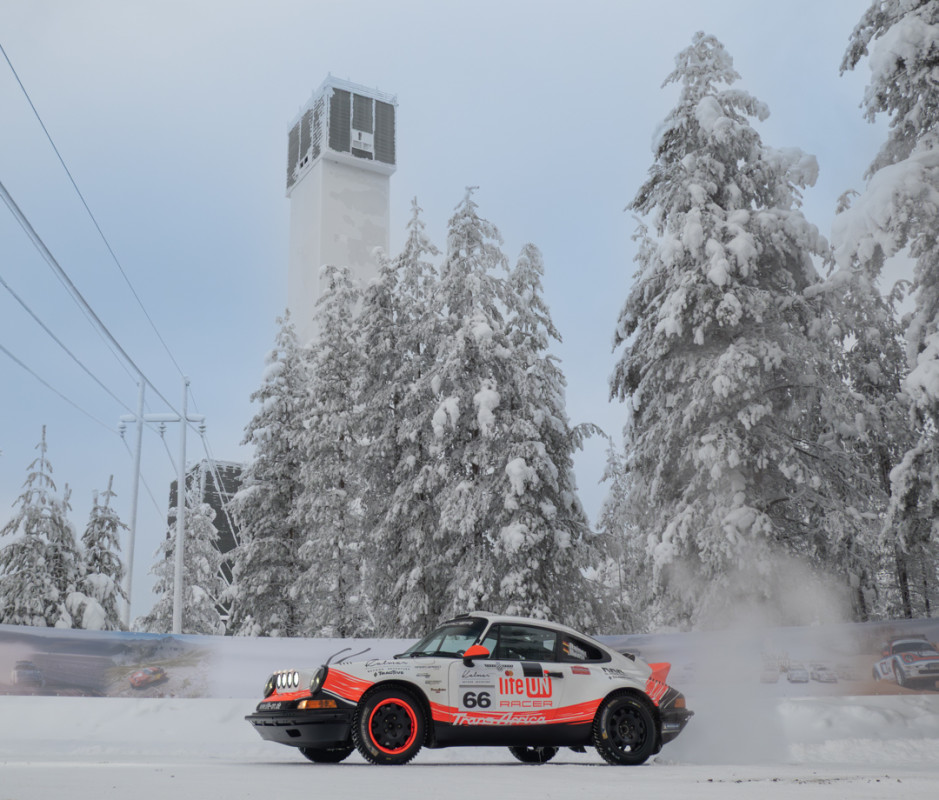
Such a statement bears some context, in this absurd career called automotive journalism. I once drove a Bugatti Chiron Super Sport as fast as possible through the French countryside and then ate a Michelin-starred meal on the factory floor. Lamborghini, somewhat incomprehensibly, let me drive a Huracán Sterrato at 100 miles an hour (and more) through the desert. And Ford launched even the Bronco Raptor with a day of rock crawling at the King of the Hammers race course.
Still, a day with a Porsche-centric company called Kalmar Automotive, smack-dab in the middle of a dark Finnish winter, left me lamenting that the greatest experience of a stupefyingly awesome few years may well lie in the rearview mirror.
Adventures in a Winter Wonderland
Founder Jan Kalmar spent years with Porsche proper exploring Finland for customer and media drive programs, then got fed up with the timidity typical of a regimented corporate environment and started hosting his own safari-style adventures across the globe with the motto “We start where others stop.” Kalmar himself entirely lacks tact, a trait that helps establish this trustworthiness as something between a modern mad scientist and an 18th-century expedition leader. The builds required to live up to both his mindset and that slogan—911s of all generations, but also Cayenne SUVs and even mid-engined Caymans—feature extensive prep in order to survive weeks of brutal treatment across Africa, South America, and Australia.
A Kalmar trip always stops at the most spectacular locations available, either erecting tiny tent cities or loafing about the swankiest hotels on Earth. But the regulation-style rally timing forces Kalmar’s participants into a level of camaraderie so often lost in the otherwise ostentatious indulgence of so many resort-style vacations. Then, the realization hit that all the suspension lifts, armoring, and off-road kit also perfectly prepared Kalmar Automotive’s cars for ice driving—and so the journey came full circle, back to Finland for a separate winter series dubbed “Spirit of Speed.”
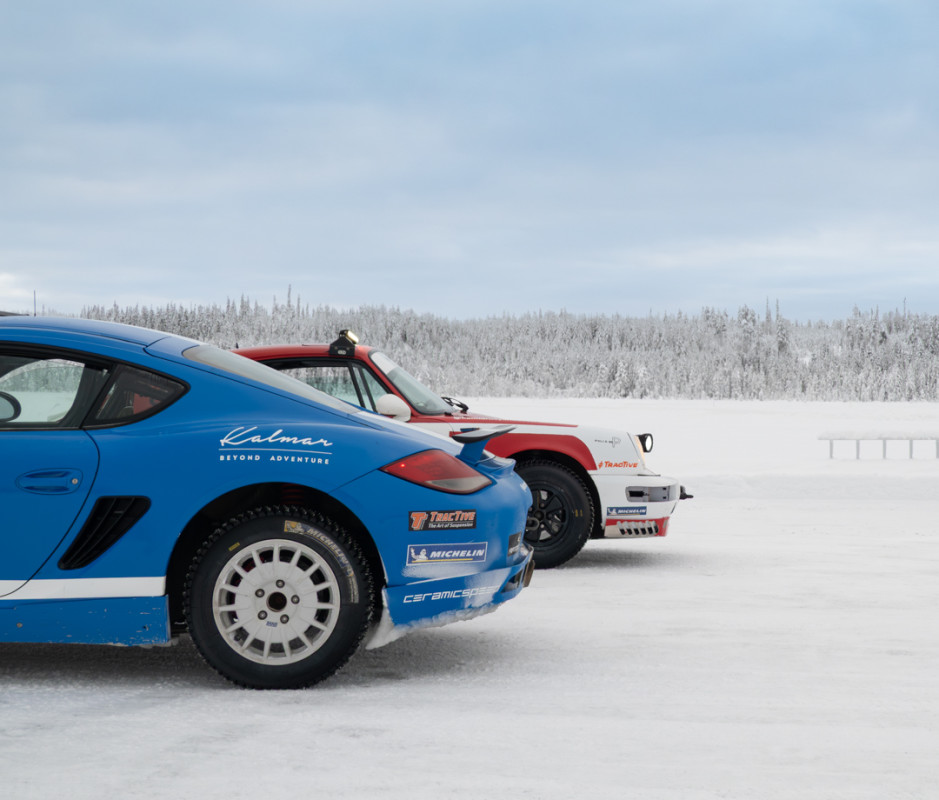
“We do not change anything on the cars when we go through the jungle in South America or through the desert in Africa,” Kalmar said. “All the protection we made, I realized that’s actually really good for snow and ice. So suddenly we had this program that was not only winter, but was more of a society, in a way.
“That’s not to say our people first go to winter and then they go through summer. It’s absolutely crossover, we have many that have done first summer and then go to winter and then winter that have gone through summer. I think what people appreciate with us, is more the DNA that we are in it with our clients. We stay in the same lodge. We eat together with them. I don’t do master and servant, and the ultra-rich actually appreciate that, like they can be themselves.”
Kalmar believes in skipping helmets and HANS devices for winter driving, a signal of the relative low risk and high reward inherent to sliding around on ice or in snow. But perhaps the main factor that separates the hardcore spirit at Kalmar’s program comes down to the tires, full world rally-spec studded rubber that Michelin provides to take Spirit of Speed to another level of, yes, speed. In fact, the tires need to go back to Michelin at the end of each 10-week season Kalmar spends southwest of Levi, Finland, so that other tiremakers can’t tear them apart and reverse engineer the technology within. Compared to previous ice driving I’ve done on road-legal all-season, studless winter, and studded tires, the pace immediately took my breath away.
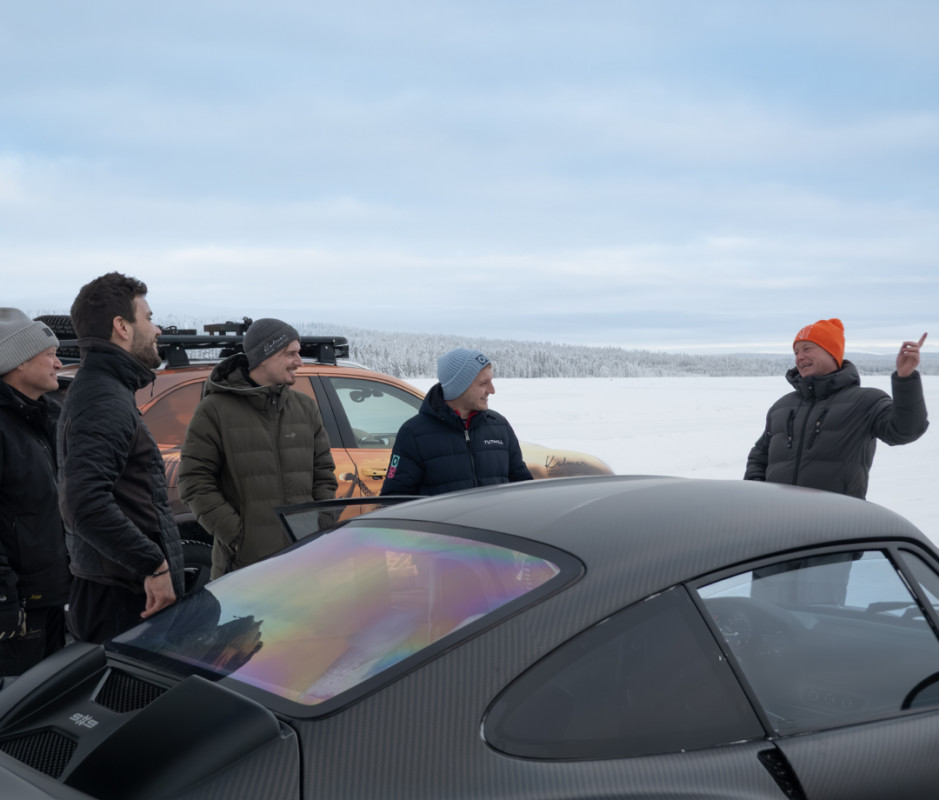
Comprehending the Kalmar Way
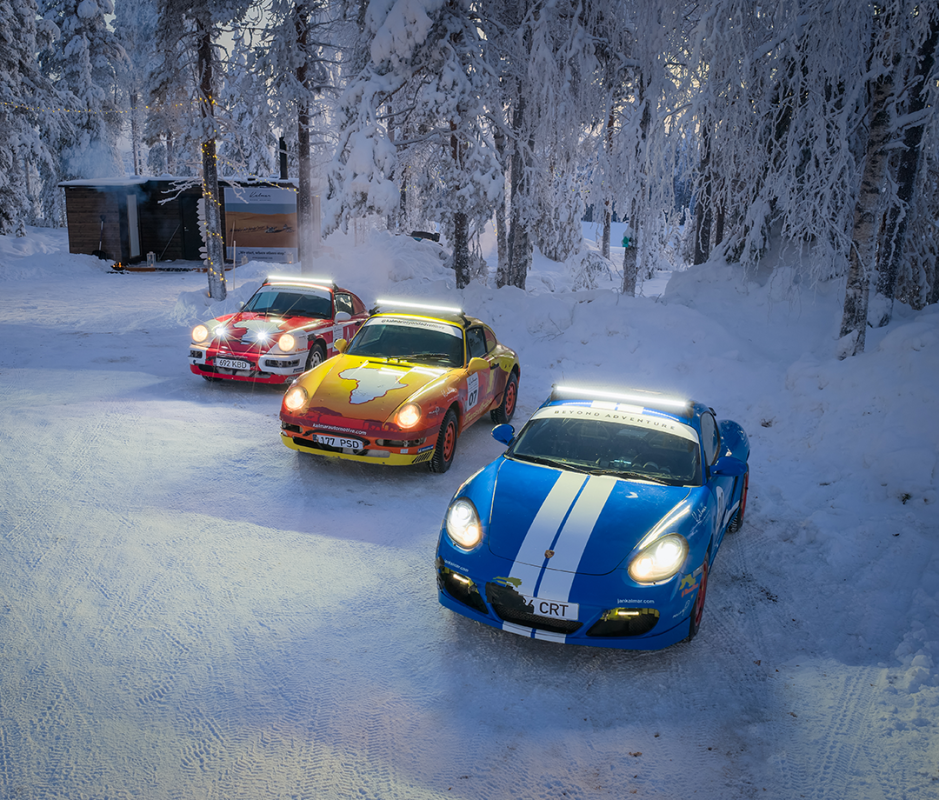
My first car, a modestly stock (in Kalmar terms) 964-generation Porsche 911 nicknamed Red Dot, gave me a chance to adjust to rear-engined weight distribution. And nowhere reveals a vehicle’s inherent balance better than an icy surface—hence why automakers spend so much time accelerating development timelines in winter driving. But the 964 is still a fairly primitive car, in many ways more similar to a Porsche from 1964 than 2026 thanks to torsion bars and trailing arms, primitive rack-and-pinion steering, and that air-cooled engine. Kalmar updated Red Dot with the most utilitarian “RS” (for “ Rally Special”) components, including a suspension lift with reinforced top mounts and spring plates and upgraded axles to handle more wheel articulation, all as the narrow WRC tires looked almost comically narrow beneath the quintessential 911 rear fenders.
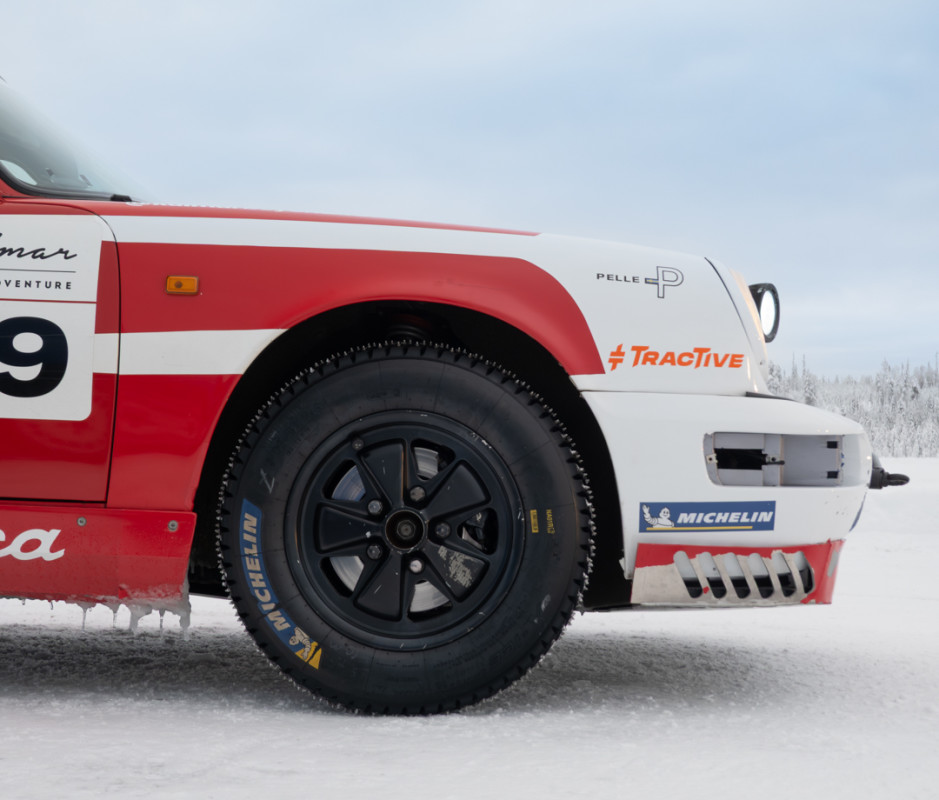
And yet, as I got into the groove with the light steering, floor-hinging clutch, and buttery shifter, I started to sling around harder and wider, opposite-lock on full display until I punched too hard into the throttle and spun out for my first time on the donut circle. Hopkins coached me to keep my vision up and around the ring, to trust steering inputs less and instead direct the car more by harnessing weight transfer and throttle input, letting those tungsten studs find grip purposefully. Then I brought out a laugh by whipping around in a purposeful 180 to drive the other direction.
Right as I started to feel an edge of confidence in Red Dot, Hopkins got bored and swapped me into a 993-gen 911 wrapped in a yellow African-inspired motif and fittingly named “Rising Sun.” Still air-cooled, the 993 generation added a multi-link rear suspension and at least for Rising Sun, much heavier steering. The weight and power gains for this final 911 before water-cooling immediately allowed for easier slides, as the rear end’s refinement skated across the ice much more smoothly. But the 964’s tail end felt less pendulous by a fair margin—plus, the seating position fit my six-foot-one body a bit better.
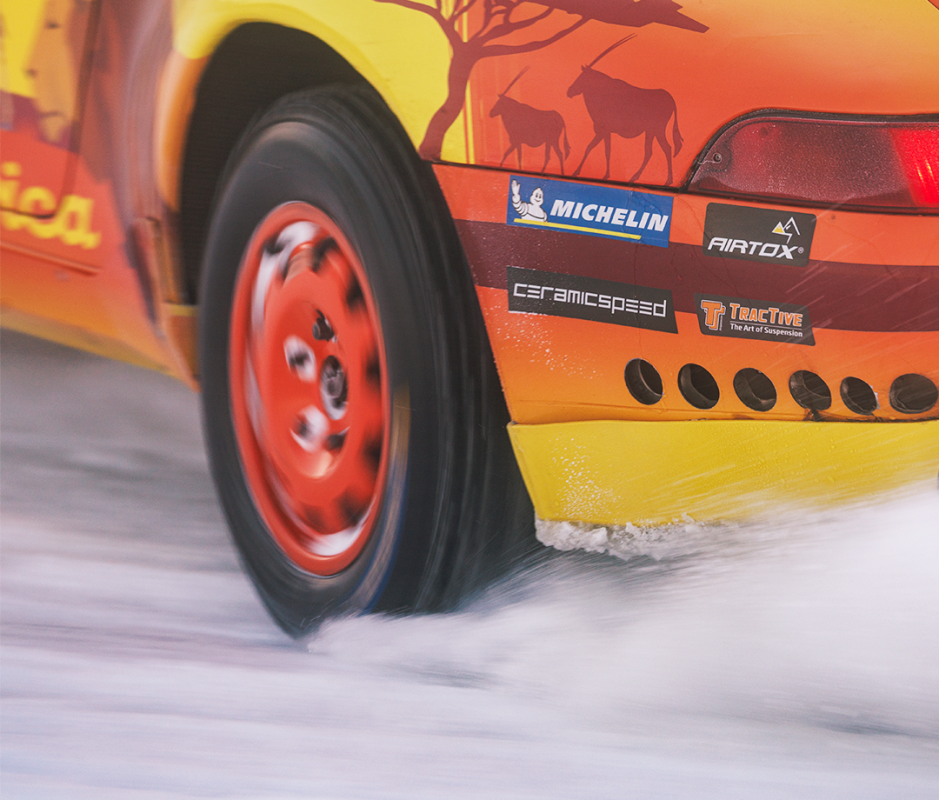
In Rising Sun, I quickly graduated from the intro slalom and donuts to chasing Hopkins around the beginner circuits. Customers might take a full day on these steps alone, but I spent my single available day essentially condensing a typical three-day Spirit of Speed program into one. I figured plenty of previous ice and off-road driving helped accelerate my development, but Jan Kalmar actually explained how many customers return year after year—and how hard they push, often finding their own limits and the limits of their own cars.
“When they come here, even the 64-year-old ladies, they’re like, ‘I want to go faster, faster, how do I do this more?’” he laughed. “And that’s kind of what we try to achieve. So in a way, we lure them a little bit in with pictures of nice lodges and everything, but we are here for driving….”
Mid-Engined and Modern, But Is That A Good Thing?
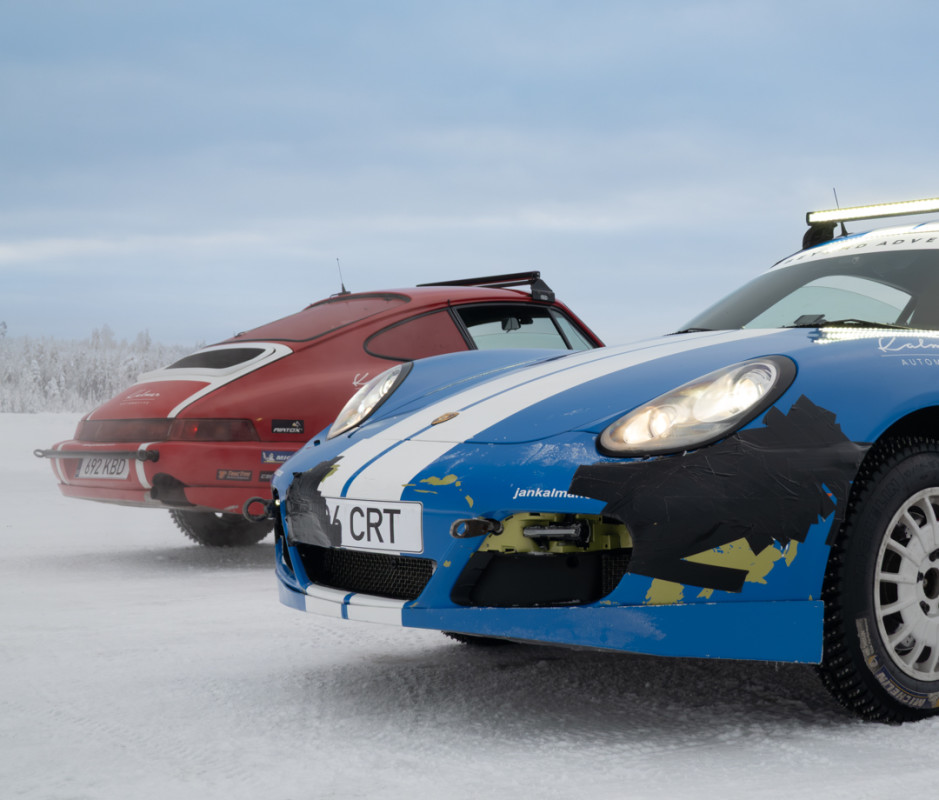
Soon enough, I jumped into my first of multiple customer cars on site, a Cayman R wrapped in blue and known as Mustang Sally. Nobody could tell me the satisfactory origins of that moniker, but Hopkins waylaid any fears I felt about pushing Mustang Sally hard by pointing out the swath of duct tape on the nose—where the owner had just the previous week jumped his own Cayman into a tree. Don’t be that guy, I figured as usual. But I also needed a whole ‘nother adjustment period, since Mustang Sally represented a return to my more typical mid-engined life, with feathery power steering and a paddle-shifted automatic gearbox built with much shorter gear ratios.
I quickly abandoned the paddle shifters, instead using the typical gear selector on the center console to hold the PDK mostly in third, fourth, and fifth gear as I whipped the steering wheel from side to side. The introduction of far more modern and effective anti-lock braking also threw me for a loop—literal, not figural—as the chattering at my toe sent more grip into the nose, which automakers purposefully prompt to provide more easily controlled understeer. But understeer sucks on an ice course, typically resulting in getting beached up on a snowbank, so I then overcompensated with too much throttle and spun out a few times.
Finding the Flow State Once More
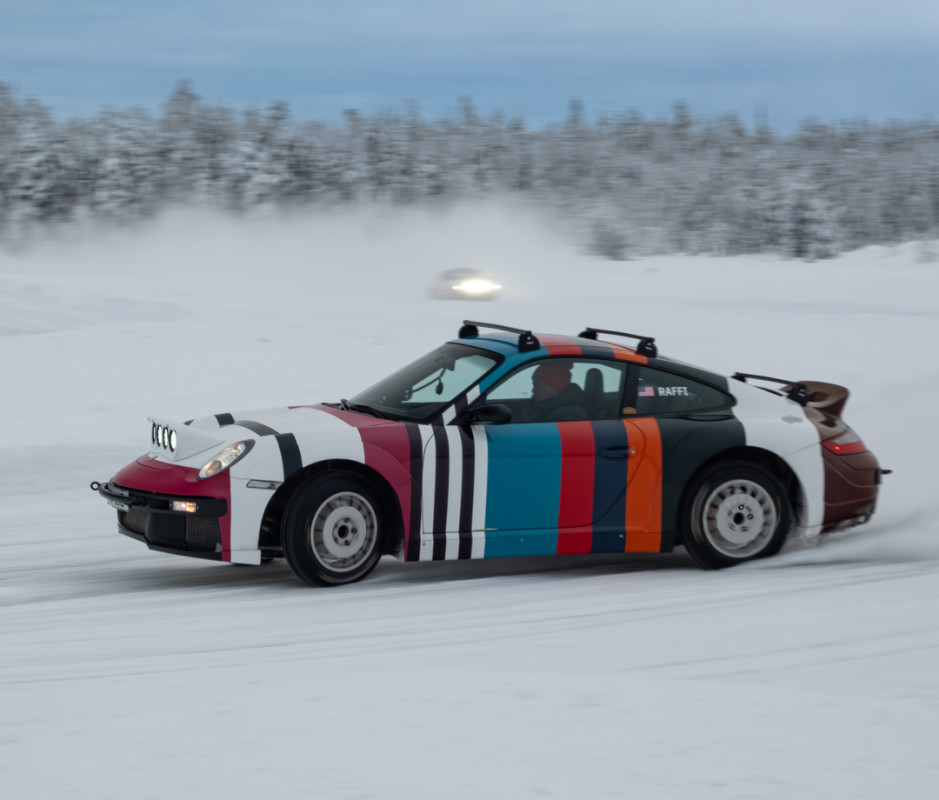
After a quick break for lunch, a hearty Nordic stew and piping hot coffee plus a moment to warm up next to the woodstove in a cozy minimalist hut, the day proceeded onto a trio of more rallycross-inspired circuits. Here, the ante upped in a big way, with far more elevation change than a flat frozen lake, tighter paths surrounded by deeper berms, and inconsistent lighting to blind my eyes amidst the white nothingness. The additional risk seemed a bit over the top for me to keep up the revelry in the RS-R, so I jumped back into my “normal” 964, Red Dot, once again.
Hopkins gave me a quick tip about left-foot braking, advising me to keep my knees pressed together as I wiggled around in Red Dot’s looser seat. Rather than dedicated trail braking or trying to minimize time lost by moving my right foot from throttle to brake, I started physically pushing both pedals at the same time. With the 911’s rear-engined weight distribution, front brake bias, and high-revving power delivery, I started absolutely nailing a magic combo of precision at greater and greater speeds. Red Dot spun on a metaphorical and physical dot every time now, fully backing in while the tip and tail brushed and skirted snowbanks with balletic precision.
Faster and faster, until the thrill of speed overcomes the fear of death—or worse, the killing of a sacred car. And yet, eventually my skills steadily caught up to the pace. Nothing beats the sensation of linking up tight transitions: Jump, dive, slide and hold, trust, then goose in some power and again jump, dive, slide, and hold, more trust and more trust, vision ahead, searching for grip where snow and ice look perfect, and out onto long sweepers at 100, 130, 160 kph sideways, holding steering angle beyond belief, before timing a heel-toe downshift with more precision than ever and starting the whole dance again.
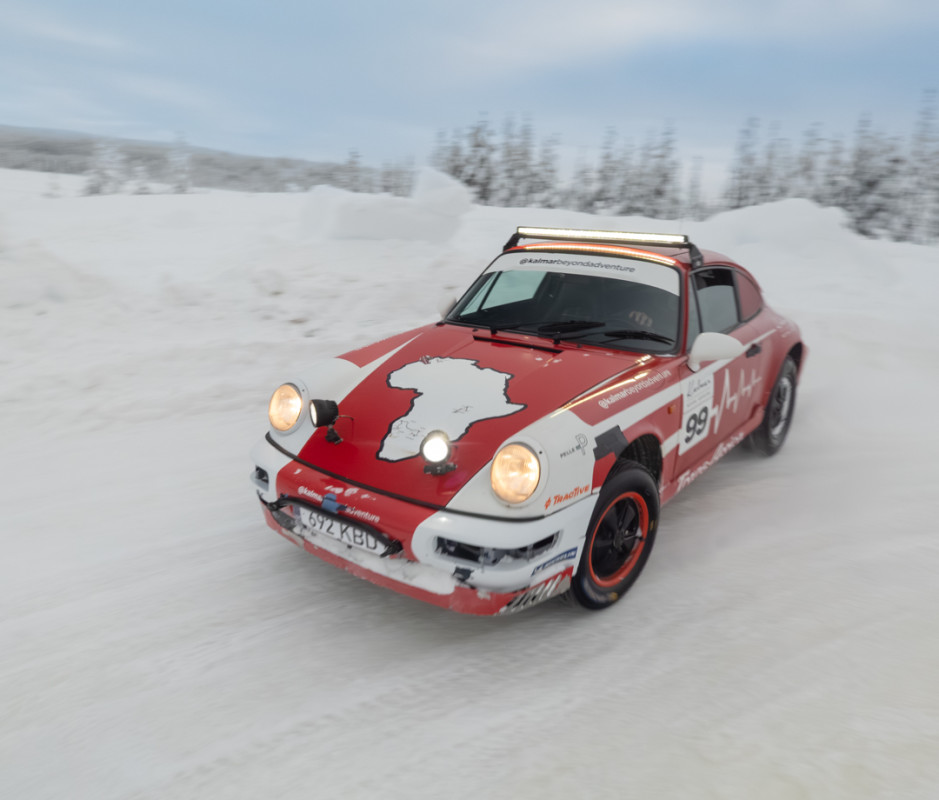
Therein lies the magic of Kalmar’s approach, clearly not using these Porsches as garage queens but almost more importantly, never treating me like royalty either. Adapt, evolve, improve—less you face an angry coach, even light ribbing, or true ridicule if the moment calls for a bit of peer pressure.
Then Hopkins came on the radio again, telling me to cut out the pretty stuff and step up my pace. And not just by a bit, by a full 10 percent: he wanted me to purposefully push past my limits and lose control. Immediately, I whiffed about and stuffed it backward directly into a snowbank. No damage to Red Dot’s tail, though, so I just powered back out and kept trying. Another spin, I simply kept on the gas to push up and through the pile of snow, trusting the WRC studs to create grip in the fluff.
“In the first three turns, we know how our next few days are going to be,” Kalmar said. “Only with adult people, self-thinking individuals and not robots, is that possible. We ask, ‘Do you want to learn more?’ And most of our guests say, ‘Of course, that’s what we’re here for!’”
Riding High on Victory
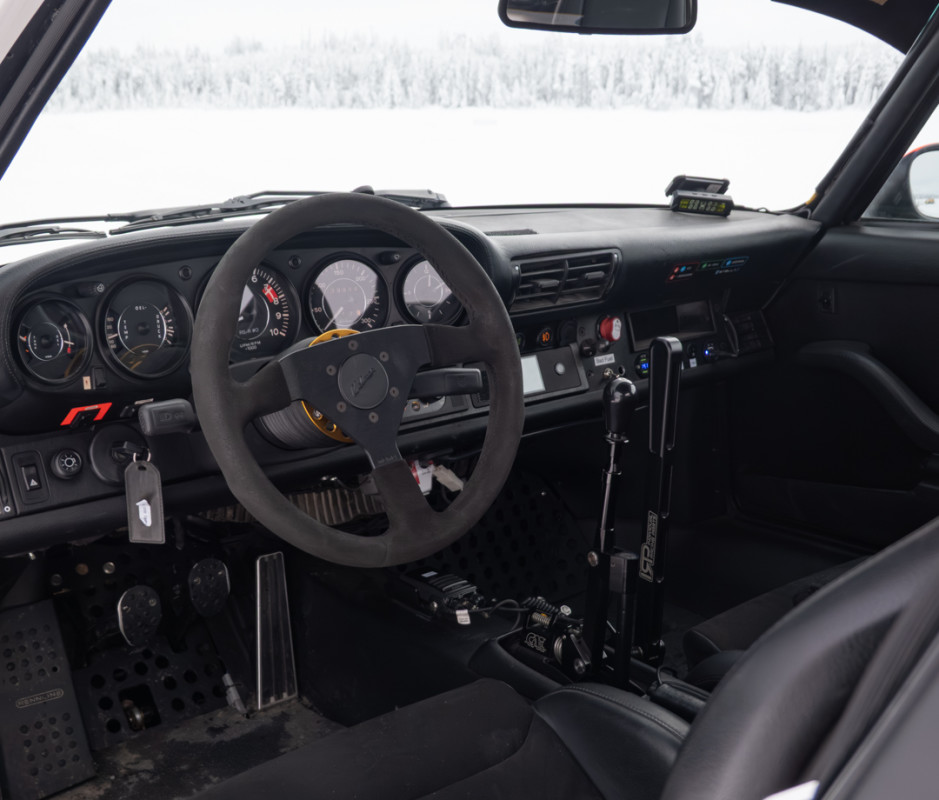
The next launch I spun the tires a bit too much, but nailed the whole course—even the hairpin and the stop box, which brought on the very limit of the 964’s primitive ABS. Hopkins whistled, claiming I’d just set the second-best time of any customer ever, with a 1:17.37. I laughed, incredulous, and told him I felt like I’d left a lot more on the table.
I whiffed the third launch badly, revving too hard in adrenaline junkie mode and killing my acceleration before the first corner. But again, absolute glory on the rest of the course, and a finish with an over exuberant final braking point that led to my front axle stopping just on the right end of the stop box line (count it!), though going that long maybe added a few hundredths of a tick. Still, I shaved another six-hundredths—not good enough for the overall record, but I set a solid second place in the slowest car out of Kalmar’s whole fleet. Not bad, I thought. Hopkins in his understated stiff upper lip British: “Good lord, you can drive, mate.”
What a compliment, and maybe the last thing a journalist’s overinflated ego ever needs to hear. But as my reward, I spent the rest of the day out on the longest 9X9 course and once again back in the greatest car ever made. Kalmar himself even came out to join us after Hopkins told him my times, and though I would have happily spent the last few hours of the day approaching automotive nirvana (or I suppose more accurately for scene and setting, Valhalla) in the RS-R, a new idea began to crop up.
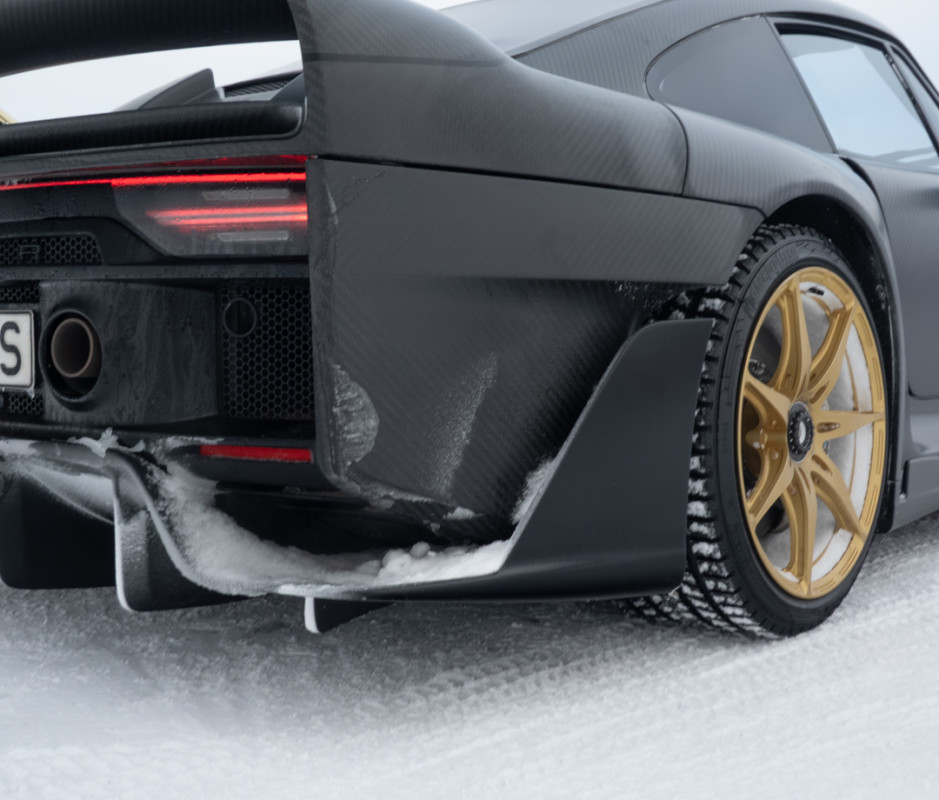
Apparently, Kalmar felt impressed enough that I might not crash the actual 9X9, so he reached a decision: I’d be the very first journalist to ever drive the car on ice. He personally asked me to use a bit of caution, since just the front carbon splitter costs more than all the cars I own combined. Even at two-thirds, then three-quarters pace, though, the 9X9 on the 9X9 course unified everything into one single frame. Modern suspension, so taut and yet smooth because of the weight savings and an innovative third element that helps with both mass control and aero, wider tires and yet no WRC studs, an absolutely perfect chassis for absorbing the lumpy and wavy ice without ever getting herky-jerky. And of course, the miracle of a modern GT3 powertrain, in a way reminiscent of the RS-R’s 4.1-liter but with even quicker throttle response, so much more power, revs to infinity and beyond, the stubby shifter just a thing of beauty.
After approval for an extra lap, when I managed to nail a few nice turns and crank out plenty of steering angle despite lacking that final edge of commitment in something so precious, I swapped back out. Everyone sort of chuckled—here’s what two million (to start!) and years of knowledge, skill, driving, and breaking stuff can get you. Lightweight, rear-engine, aero supremacy, and a good-old-fashioned clutch pedal. Not quite a restomod, though enough of one to count for registration in stricter regions, but also something far more engaging than any supercar. And I’ve driven them all (or near enough).
Finding the Flow State Once More
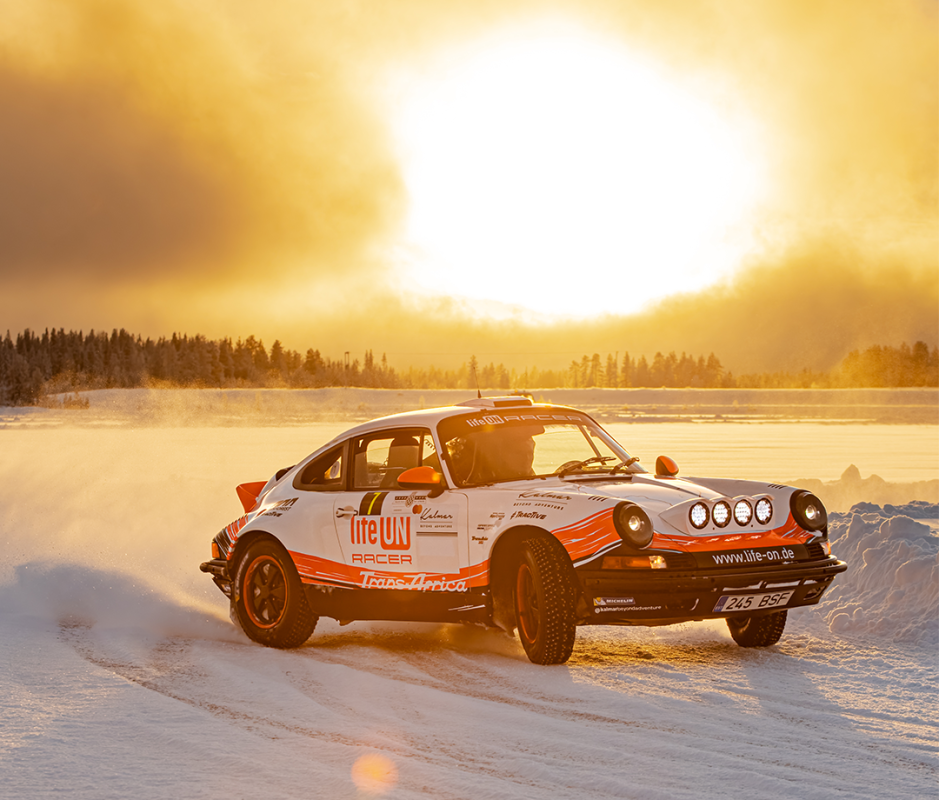
But would I take a brand-new 9X9 over my beloved RS-R? Personally, the rally pods and rougher edges of the older car fit my life so much better. Hopkins saw the glint in my eye, sun starting to sink low, so he showed me how to flick on those rally lights and set me out for as many laps as the minute hand might let me run. How to hold onto, grasp desperately at, fleeting perfection?
The RS-R and I fell into our flow again immediately, sun entirely dipped below the horizon now, lights blurring the low snowbanks as I reached that specious existence where physical existence moves through time without the interference of conscious effort. Senna at Monaco, Jordan in the ‘flu game, Doc Ellis painting the corners in his LSD No-No…