Suicide Bombs Reveal Nigerian Jihadists’ Enduring Resolve
The Attacks in Maiduguri: A Sign of Strength or Desperation?
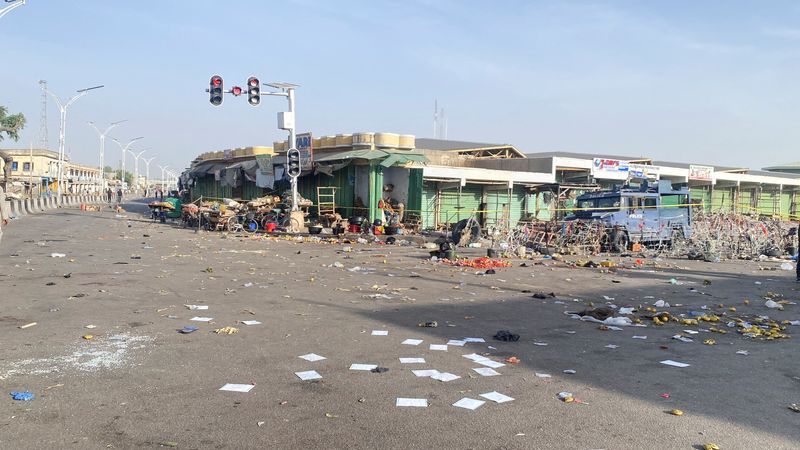
Nigeria’s president recently referred to the recent attacks in the northeast’s most heavily defended city as “the final desperate” acts by militants aiming to spread fear. However, many experts argue that these bombings are not signs of weakness but rather a demonstration of strength and capability by Islamist militants.
The assault on Maiduguri, carried out by coordinated suicide bombers, highlights significant intelligence failures within the state and the growing ability of militant groups to strike urban areas despite ongoing government operations against them. It remains unclear which specific group was responsible for the attack, underscoring the complexity of a 17-year-long insurgency that has claimed tens of thousands of lives and displaced millions.
Analysts Warn of a New Wave of Attacks
Analysts believe that the recent series of attacks, including those conducted by both Boko Haram and ISWAP (an Islamic State-allied faction), may indicate some level of coordination between these often-rival groups. Ikemesit Effiong, a partner at SBM Intelligence, stated that this could be a sign of increased confidence among the groups in their ability to carry out terror attacks in the region.
“We think this is the start of a spate of bombings, not just in Maiduguri but also less protected urban areas in the northeast,” Effiong said. This suggests that the militants are not only targeting high-profile locations but also expanding their reach into more vulnerable regions.
President Bola Tinubu has pledged additional support and equipment for the military, vowing to “completely defeat” the militants. However, such promises have been repeated by previous administrations without significant success in curbing the violence.
The U.S. Involvement and Military Operations
As violence spreads across Nigeria, including into the northwest, the U.S. military has taken steps to intervene. Recent air strikes and the deployment of military advisers have been part of this effort. However, it is still unclear whether U.S. troops will be directly involved in responding to the bombings.
Nigeria has been battling Islamist militants in the northeast since 2009, when Boko Haram first emerged in Maiduguri, seeking to establish an Islamic state. A violent crackdown led to the death of the group’s founder in police custody, and the militants were driven from urban areas. Since then, the group has splintered, giving rise to factions, one of which declared allegiance to the Islamic State and has become the most powerful, controlling large parts of northeastern Nigeria.
ACLED, a crisis-monitoring group, reported that Monday’s attack was the deadliest suicide bombing in Nigeria in seven years. According to Vincent Foucher, a senior research fellow with the National Centre for Scientific Research in Bordeaux, the jihadists have managed to establish control over substantial rural areas, while the military holds onto towns that are well-entrenched.
Intelligence Failures and Strategic Challenges
Malik Samuel, a senior researcher at Good Governance Africa, pointed out that the ability of militant groups to strike anywhere in Borno state raises serious questions about the effectiveness of intelligence efforts. Carrying out three simultaneous attacks in a city hosting the military headquarters indicates potential lapses in security and intelligence.
Samuel and other experts believe the attack was likely carried out by Boko Haram, which has a history of suicide bombings. However, Effiong and two security sources did not rule out collaboration between Boko Haram and ISWAP.
“Clearly, it means Maiduguri is not as safe as the authorities would want people to believe,” Samuel said. “Attacking Maiduguri is symbolic for these groups.”
Escalating Violence and International Response
Jihadists have intensified their attacks on the Nigerian military during the Muslim holy month of Ramadan, resulting in the deaths of dozens of troops, including senior officers, and the seizure of equipment. Samuel noted that this indicates the militants are “not going anywhere, anytime soon.”
The United States has maintained a long partnership with Nigeria’s military, providing training and selling weapons. Recently, the U.S. carried out air strikes in the northwest to prevent the targeting of Christians in the region. About 100 troops have since been deployed to support the military, and the U.S. provides intelligence through aerial surveillance.
One security source mentioned that this intelligence led to the destruction of four ISWAP gun trucks on March 11. However, Effiong argued that this involvement also exposed the government to accusations of being a Western ally, potentially fueling recruitment among jihadis.
Foucher highlighted the limitations of U.S. military action, noting that the faction targeted by U.S. Tomahawk missiles in December remained operational. He described the situation as “whack-a-mole,” emphasizing the difficulty of addressing multiple conflicts simultaneously.