U.S. Reveals and Destroys Iran’s Largest Underground Secret
Iran was trying to hide a big underground secret. Buried under mounds of soil and concrete, this secret was supposed to be completely concealed from the entire world. But the U.S. found it. And with the secret uncovered, the U.S. unleashed the most powerful bunker buster bombs.
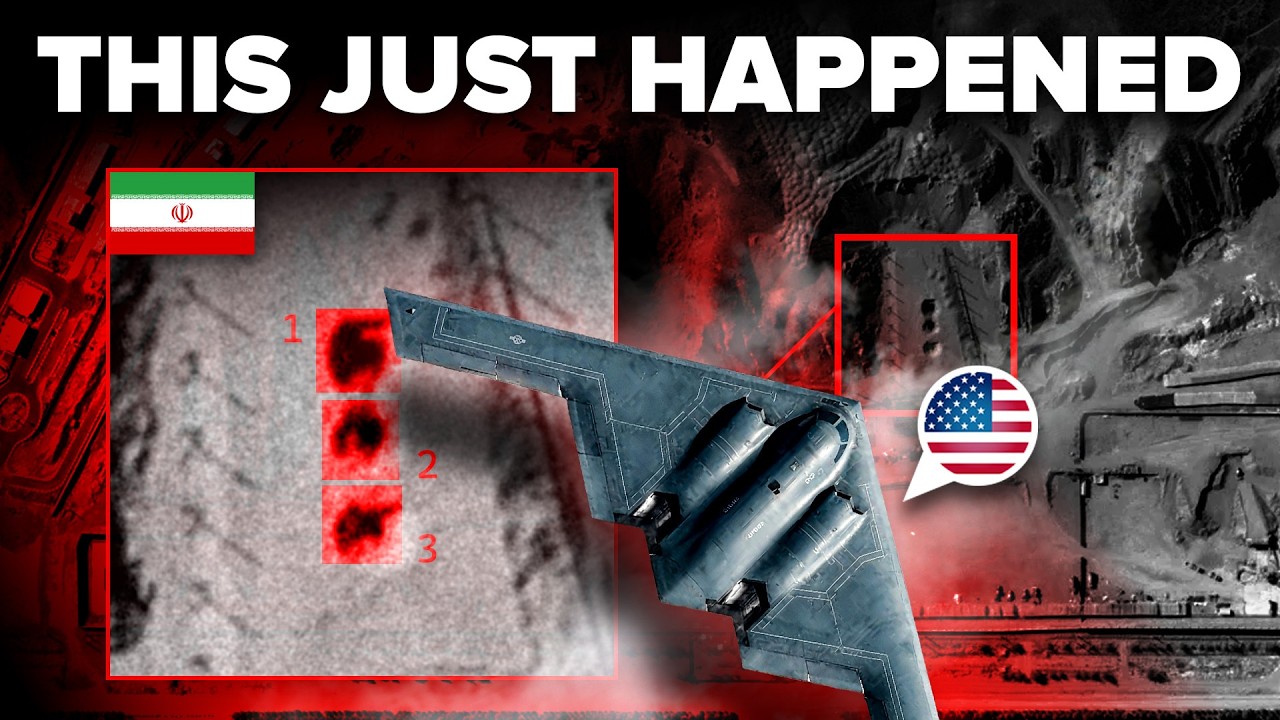
Concrete was turned to butter. Nothing survived. Once again, the B-2s have shredded Iran’s defenses as though they don’t even exist. How do we know all of this? Three holes. That’s what has been seen in Iran’s Taleghan 2, as captured in satellite photographs released by Vantor. But these aren’t any old holes. As The War Zone, or TWZ, points out, these holes are huge, and they look like a trio of large impact points that almost certainly point to the U.S. of America’s largest and most devastating bunker-busting bombs at a site that has clear ties to Iran’s nuclear program.
We’ll be revealing what bomb the U.S. used in just a moment, but it’s what the photos show us that gives the clearest indicator that the U.S. has evolved its strategy to attack some of the most protected sites in Iran.
The three holes in question are visible across the top of the Taleghan 2 facility, not uncoincidentally right above the hardened structure that is home to the top-secret projects that Iran wants to keep hidden away from view. And Iran has been working hard in the build-up to Operation Epic Fury to protect the Taleghan 2 site.
That work started in October, which is when Iran International reported that rebuilding had begun at a site that Israel had devastated once before. The construction work had actually begun before the 12-day war that was sparked by 2025’s Operation Midnight Hammer, though Iran was forced to stop as its nuclear sites were all pelted with the same kinds of bunker-busters that the U.S. just used at Taleghan 2.
A report published by the Institute for Science and International Security, or ISIS, said at the time that, “The purpose of the new construction at this location cannot be discerned from the imagery; a multitude of other non-nuclear purposes are also possible. It is deeply concerning that construction is occurring at a former AMAD Plan nuclear weapons development site, raising considerable questions as to the true purpose of the facilities there.”
As for what the construction involved, it’s pretty simple. Iran desperately wanted to protect its secret site from the very weapons that the U.S. just used to destroy it. The early signs of construction involved massive covers being placed over destroyed buildings, groundworks and foundations being laid for a bunker, and the unveiling of a new arch-roofed structure with several smaller buildings being built nearby.
Fast forward to today, and TWZ adds that Iran had continued the work by encasing the Taleghan 2 site in hardened concrete, before burying it under a massive layer of soil that was supposed to dampen the impact of any bombs dropped on the facility.
So, we start to see a picture being formed here. As the main facility was being built, the small buildings surrounding it may have been constructed to serve as entrances and exits into the underground bunkers. Iran’s problem is that all of this was caught on camera. It’s not exactly easy to hide the construction of a new secret site when satellites are constantly flying overhead.
The U.S. and Israel knew exactly what they needed to strike from the moment that construction began, so all they would need was the right weapon and the correct timing.
Iran must have known all of this was coming. Taleghan 2 had been hit before. Back in October 2024, Israel launched a strike against the site, causing major damage, according to ISIS.
The same institute notes that Taleghan 2 was likely being used to make high-purity PETN plastic explosives, which are key to the construction of shock wave generators. Likely built as part of the “Amad Plan,” these generators, which are also referred to as distributors, were likely being built by Iran so that it could miniaturize its nuclear weapons designs.
Smaller nukes can be dropped with far less effort than larger bombs, so it seems like the bunker that the U.S. just busted was playing a role in Iran’s nuclear program in the past. Maybe the U.S. has intelligence suggesting that the new and improved Taleghan 2 was built for the same purpose.
It doesn’t matter now. The site has been destroyed for a second time.
ISIS also reveals the damage that the U.S. caused when it turned Iranian concrete and soil into butter. Of course, we can’t see everything. Three holes in the ground only reveal so much, as all of the damage will have been done dozens, if not hundreds, of feet below the Earth’s surface.
But what we do know is that the three holes ran across the length of a facility that served as a suspected high-explosive test chamber. Again, for nuclear weapons-related testing? We can only speculate. Still, the holes also make it clear that the U.S. bunker busters smashed their way through the massive concrete casing that Iran hoped would serve as protection for the facility.
That is not good for Iran. With the concrete penetrated, the bunker-busters would have exploded inside the Taleghan 2 facility itself. ISIS says that this is supported by more evidence in the satellite photos that show a protective defensive wall outside of the facility’s northern entrance being heavily damaged. This indicates an outward blast from the U.S. bunker busters, which in turn indicates that those massive bombs made it through Taleghan 2’s protective layer and exploded precisely where they were supposed to explode.
Another building, located southeast of the main facility, also seems to have been partially destroyed, likely due to a concussion effect caused by the main bunker blasts.
What we have here is evidence that the U.S. hit its target perfectly. And it has to have been the U.S., and not Israel, because the weapon used is one that only the U.S. has in its arsenal.
The 30,000-pound Massive Ordnance Penetrator, or MOP. Also known as the GBU-57/B, this bomb seems to be the only viable candidate for having caused the holes that we see in the satellite photographs.
Everything we see is consistent with MOP usage, TWZ adds, as the massive holes are similar to those that appeared over the Fordow and Natanz nuclear sites in the wake of Operation Midnight Hammer.
We know for a fact that the U.S. used MOPs in those attacks, specifically 12 on Fordow and two on Natanz, so the above-ground view of Taleghan 2 is more or less all that we need to confirm that the U.S. pulled the same trick again to take out yet another of Iran’s hardened underground facilities.

That’s not to say that there weren’t other options. The GBU-43/B, often called the “Mother of All Bombs,” or MOAB, is another candidate. So named because it was once the most powerful non-nuclear weapon in the U.S. arsenal, before the MOP came along, this 21,000-pound bomb was built in just nine weeks to support the 2003 Operation Iraqi Freedom.
Typically launched from a C-130 Hercules, the MOAB would be pulled off the plane using a drogue parachute, and, once in the air, its grid fins open to stabilize the bomb and guide it to its target.
The bomb is a heavy hitter, as is clear from the fact that it delivers an 18,700-pound warhead that combines TNT, aluminum, and cyclotrimethylene trinitramine to deliver an absolutely enormous blast.
But it wasn’t the bomb for the Taleghan 2 job. How do we know? The clue is in the launch. A MOAB has to be dropped from a plane like the C-130 Hercules, which means the U.S. would be taking a massive risk to hit Taleghan 2 with this massive bomb. Any plane it sent would have to fly into the middle of Iran, and, as importantly, the planes that can drop the MOAB aren’t stealthy. They’ll turn up on air defense radars and could become targets. Yes, Iran’s air defenses have been devastated. By March 12, reports suggested that about 80% of those defenses were gone. But that still leaves 20% of Iran’s scattered air defenses that could fire at what is essentially a cargo plane carrying a MOAB, and that’s a risk that the U.S. simply isn’t willing to take.
It has to be the MOP, dropped by the stealthy B-2 bomber.
And in a moment, we’re going to explain why the MOP was the perfect bomb for destroying Taleghan 2.
As for the MOP, it brings a lot more to the bunker-busting table than its massive weight and enormous firepower. As Army Recognition points out, this is a bomb that was designed for the specific purpose of destroying fortified and deeply buried targets.
Interestingly, it was developed following post-2003 military assessments, which suggests that the U.S. had identified issues with the MOAB and decided that it needed something that was more fit for purpose. Boy, did they find that in the MOP.
The bomb is designed specifically to penetrate hardened targets through kinetic force, with a delayed internal detonation occurring after the bomb has broken through whatever barrier stands in its way. A hardened casing, combined with the high velocity of the impact, ensures that the MOP stays intact until the time is right to unleash its internal explosive.
As for the warhead, it’s not as massive as the 18,700 pounds of explosive fury packed into the MOAB. But at between 4,590 and 5,732 pounds, the MOP still delivers a blast big enough to cause major damage, especially when that blast is being contained within the underground bunkers that the bomb was designed to penetrate.
Add 60 meters, or about 200 feet, of penetration into that package, and you get a bomb that was impossible for Iran to defend against. That’s perfect for the U.S. and Israeli strategy, which seems to have been to hit Taleghan 2 hard with the bunker busters, and then follow up with attacks to take out the above-ground portions of the site.
Stick with us, and we’ll explain why 30,000-pound MOPs weren’t the only thing that Iran had to worry about at the site.
Before we get to that, it’s worth pointing out that everything we’ve discussed so far is educated speculation based on what we’re able to see from satellite images. As of March 14, the U.S. has neither confirmed nor denied the use of MOP at the Taleghan 2 site.
TWZ even attempted to verify its report on the strike by reaching out to U.S. Central Command, or CENTCOM, though it was met with CENTCOM refusing to comment on the ongoing operation.
However, what we’ve seen so far is consistent with the use of MOPs, and we know that the U.S. has been sending B-2 Spirit stealth bombers into Iran, which is the only airframe currently capable of dropping the giant bunker-busters. It all adds up. The U.S. just isn’t giving up the final answer just yet.
Having said all of that, there are some differences between the MOP strikes done as part of Operation Epic Fury and those conducted during Operation Midnight Hammer back in 2025.
Key among those differences seems to be how the U.S. hit its target. At Taleghan 2, we see the holes directly over the facility’s underground structure, indicating a direct attack. However, the U.S. took advantage of ventilation shafts at the Fordow site in 2025 by dropping its MOPs into those vulnerable shafts, likely to ensure they could penetrate deeper into the site before exploding.
That was revealed by the U.S. Chairman of the Joint Chiefs of Staff, Dan Caine, in June 2025, when he revealed that Iran has “attempted to cover the shafts with concrete to try to prevent an attack.” Clearly, that didn’t work. But it does raise some interesting questions about why the U.S. seems to have chosen a different approach in its most recent MOP strikes. Chief among them is why weren’t ventilation shafts used again?
The obvious answer might be that the Taleghan 2 facility didn’t serve quite the same purpose as the bunkers that the U.S. took out during Operation Midnight Hammer, meaning ventilation shafts weren’t even there to target. However, another answer may come from what we mentioned earlier about the measures that Iran took to try to protect Taleghan 2.
Soil and concrete are all well and good, but they have to be deep to stop an MOP that can push through 200 feet of concrete to get to where it needs to go. Based on the satellite photos we’ve seen of the Taleghan 2 site before and after the covering, maybe this was just a case of the U.S. hitting the site directly for a much simpler reason. It could. The site wasn’t as protected as Iran needed it to be.
Iran would have felt the pain from the bunker busters already. But what it may not have expected is what we mentioned a few minutes ago, the follow-up strikes.
With the bunker itself taken out of commission, you could argue that the work was already done. Whatever was happening in Iran’s secret facility was finished, but the U.S. and Israel wanted to take the Taleghan 2 site from being out of commission to utterly obliterated.
Israel took the lead on the follow-up. TWZ reports that the Israel Defense Forces, or IDF, claimed that it struck the Taleghan 2 facility overnight on March 11. The IDF doesn’t have MOPs, so we can rule out its using those bombs as part of the initial strike. But what it does have are 2,000-pound bunker-busting bombs that it may have used to conduct follow-up attacks on the underground facility.
The holes were already there. All the IDF’s airframes would need to do is fly over and drop ordnance.
ISIS has also taken to X to reveal more damage caused to buildings close to Taleghan 2, as demonstrated by satellite photos. On March 12, ISIS shared that fire control and instrument buildings to the west of the Taleghan 1 facility, which is right next to Taleghan 2, had also been destroyed. This wasn’t done by the U.S. bunker-busters. These buildings were too far away to be taken out by concussion blasts, which suggests that the IDF’s strikes against the facility were conducted by fighter jets, which took out the external structures after the Taleghan 2 bunker was engulfed in MOP flames.
Iran is reeling. Almost a year of construction, specifically designed to protect Taleghan 2, has proven completely useless. The B-2 bomber and its MOPs showed that U.S. airpower is so superior to anything that Iran has to offer that it can shred through concrete, soil, and everything else that Iran tried to use to guard its most valuable sites.
Iran has to be wondering what could possibly come next. The U.S. likely has some ideas about that. Taleghan 2 isn’t the only site that Iran invested considerable time and money into protecting. As Reuters reported, similar work has been seen at several of Iran’s other military complexes, such as Parchin and Isfahan.
Tunnels were being buried, and entrances into facilities were being fortified up to at least February 18 as Iran prepared for what came from the U.S. at the end of that month. All of this work has been proven to have happened via satellite images, Reuters says, and all it has really done is paint a whole bunch of targets all over Iran’s other nuclear and underground military facilities.
If Iran wants to know what the U.S. will hit next with its MOPs, it’s already given itself the answers. Iran might be hoping that the U.S. is going to run out of MOPs pretty soon, or that its B-2s aren’t going to fly over Iran again. Neither seems to be the case.
While it’s true that the U.S. keeps quiet about the number of MOPs that it has in its stockpiles, we do know, due to a February 12 report by Air and Space Forces, that the Pentagon was moving to restock its supply of MOPs ahead of Operation Epic Fury. It had finalized a deal with Boeing worth more than $100 million to replace the bombs that it used during Operation Midnight Hammer. It’s believed that each of these bombs costs about $4 million, per The Financial Times.

So, over $100 million of spending amounts to at least 25 new MOPs, and that’s without considering the bombs that the U.S. still has. America has used 14 so far. And with new MOPs already on order, the U.S. appears ready to keep striking hardened underground targets if necessary.
As for the flight of the B-2s away from Iran, the Iranian regime can’t hope for that either. We know that B-2 bombers were reported to be en route to U.K. bases as early as March 4, following the U.K.’s reversal of its decision to ban the U.S. from using these bases for its initial B-2 strikes.
In other words, B-2s are being maintained, restocked, and refueled far too close to Iran for the regime’s comfort. The U.S. could send these bombers back in at any time, and Iran wouldn’t even know about it until it was too late. That’s the entire point of stealth bombers.
U.S. President Donald Trump has also mentioned that a “big wave is coming” following the arrival of B-2s at the U.K. bases. That wave could include yet more B-2 strikes on underground targets as the U.S. switches focus to crippling what the Iranian regime was trying to build, now that it has taken out so much of Iran’s military might.
What can Iran do about all of this? Not a lot, which is why it seems to have doubled down on making threats and ridiculous demands to bring Operation Epic Fury to an end.
The Islamic Revolutionary Guard Corps continues to be defiant, as it flings threats around and launches attacks against U.S. and Israeli military assets that basically amount to weak jabs to counter the constant haymakers being flung at them by the allies.
As for Iran’s political elite, they’re looking for an off-ramp, though they seem to think that Iran has more leverage than it really has.
Iran’s President, Masoud Pezeshkian, has already taken to X to outline Iran’s demands for the end of the war. “The only way to end this war, ignited by the Zionist regime and U.S., is recognizing Iran’s legitimate rights, payment of reparations, and firm international guarantees against future aggression,” Pezeshkian declared on March 11.
These are the sorts of demands Iran would be making if it were winning the war. It isn’t. Three holes at Taleghan 2 prove it, and the U.S. has plenty more where that comes from if Iran insists on defying the sheer amount of airpower that the U.S. brings to the table.
Iran, in the meantime, seems to be trying to act as though World War III is going to happen if the U.S. doesn’t stop. That doesn’t seem likely to be the case, but several conflicts could trigger a truly global war in 2026. We covered five of them in a video, so check it out to learn more.