A black hole devoured a star, creating the longest gamma-ray burst ever recorded
On July 2, 2025, the universe experienced an event that left astronomers in awe. A powerful burst of high-energy radiation emerged from deep space and continued for an astonishing seven hours. This unprecedented duration was more than 1.6 times longer than any previously recorded gamma-ray burst. Scientists quickly named it GRB 250702B, but they lacked a model to fully explain its extraordinary nature.
Gamma-ray bursts are among the most energetic explosions in the cosmos. They typically appear suddenly, burn intensely, and fade within seconds or minutes. Since their discovery in 1973, approximately 15,000 such events have been observed, none of which came close to the magnitude of what occurred on that fateful morning.
Eliza Neights, a researcher at George Washington University and NASA’s Goddard Space Flight Center, was on duty when the signal arrived. She described the anomaly as something entirely new: three separate gamma-ray bursts appearing to originate from the same point in the sky. “This is certainly an outburst unlike any other we’ve seen in the past 50 years,” she said.
A Seven-Hour Signal That No Single Telescope Could Fully Capture
Confirming the true duration of the burst required the combined efforts of five high-energy telescopes operating across different spacecraft. The Fermi Gamma-ray Burst Monitor triggered multiple times over three hours alone. Other instruments, including the Burst Alert Telescope on NASA’s Neil Gehrels Swift Observatory, the Konus instrument aboard NASA’s Wind mission, the Gamma-Ray and Neutron Spectrometer on the Psyche spacecraft, and Japan’s MAXI instrument on the International Space Station, each captured a piece of the event.
“The burst went on for so long that no high-energy monitor in space was equipped to fully observe it,” said Eric Burns, an astrophysicist at Louisiana State University and a member of Neights’ team. “Only through the combined power of instruments on multiple spacecraft could we understand this event.” Together, these instruments confirmed a duration of around 25,000 seconds. For context, the previous record holder lasted roughly 15,000 seconds, while a typical burst wraps up in under a minute.
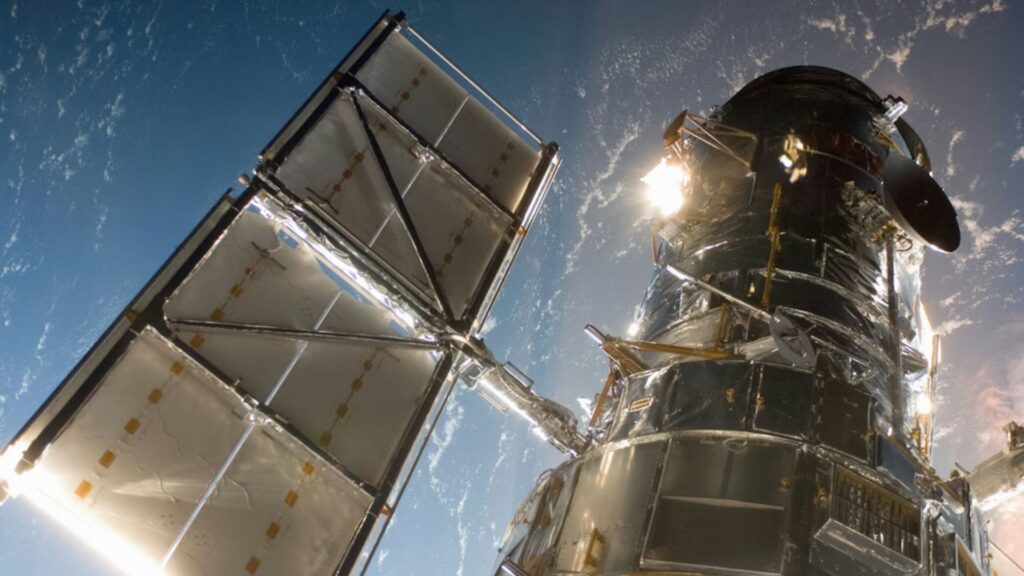
Locating the origin of the burst proved equally challenging. Early data placed it in the constellation Scutum, near the dense, dust-filled band of the Milky Way, raising the possibility it could be a closer cosmic event. However, images from the Keck and Gemini observatories in Hawaii and the European Southern Observatory’s Very Large Telescope in Chile revealed a faint galaxy at the location, and NASA’s Hubble Space Telescope confirmed it.
The Burst Traveled Eight Billion Years to Reach Us, and Its Host Galaxy Raised More Questions
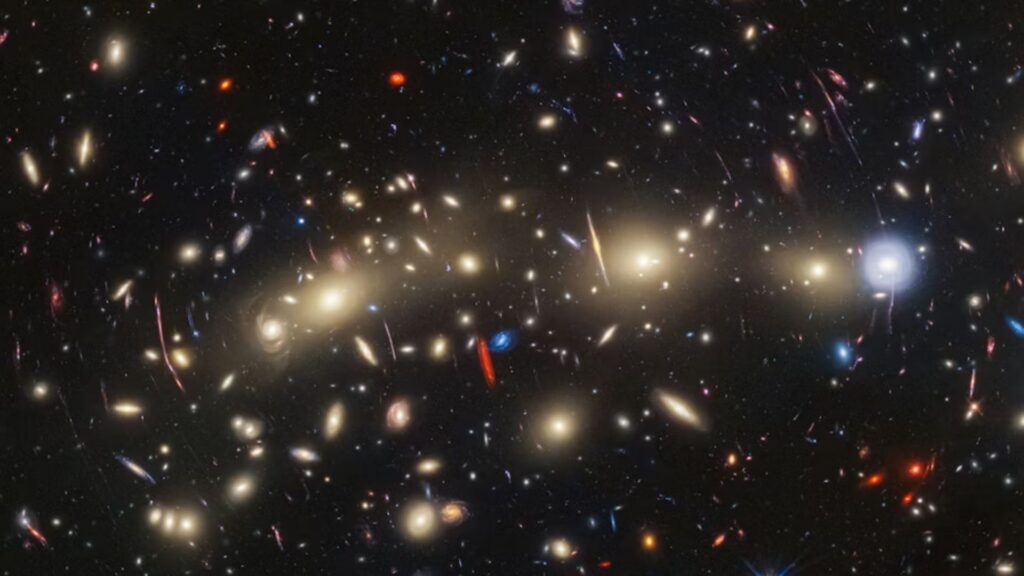
Once astronomers confirmed the burst originated from a distant galaxy, the scale of the event became clear. Benjamin Gompertz, a researcher at the University of Birmingham, led a team that used NASA’s James Webb Space Telescope and the Very Large Telescope to measure the galaxy’s distance and properties. The light from this explosion had traveled for roughly 8 billion years, meaning it erupted long before our Sun or solar system had even begun to form.
The host galaxy turned out to be just as surprising. It is more than twice the mass of the Milky Way, which is rare for a gamma-ray burst host. Jonathan Carney, a graduate student at the University of North Carolina, Chapel Hill, who led the host galaxy study, noted the galaxy’s size stands in sharp contrast to the typically small galaxies associated with most stellar-collapse gamma-ray bursts. The burst’s position also ruled out any connection to the supermassive black hole at the galaxy’s core.
Gompertz said the explosion released energy equivalent to a thousand Suns burning for 10 billion years. Webb’s NIRCam instrument also revealed a dark dust lane cutting across the galaxy’s center, and the burst had shone directly through it. “The resolution of Webb is unbelievable,” said Huei Sears, a postdoctoral researcher at Rutgers University who led the NIRCam observations. “We can see so clearly that the burst shined through this dust lane spilling across the galaxy.”
A Black Hole Eating a Star May Have Powered the Longest Explosion Ever Seen
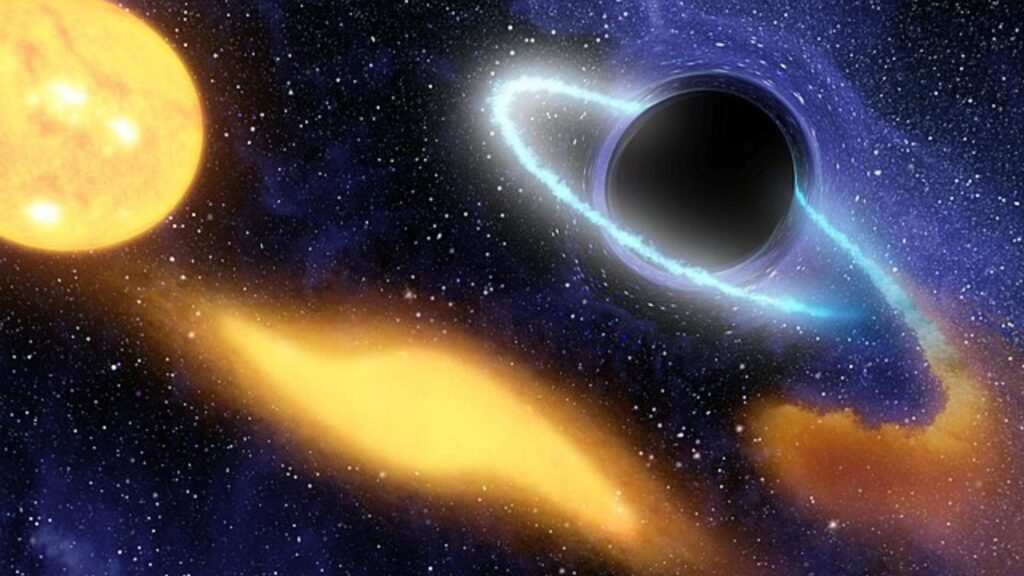
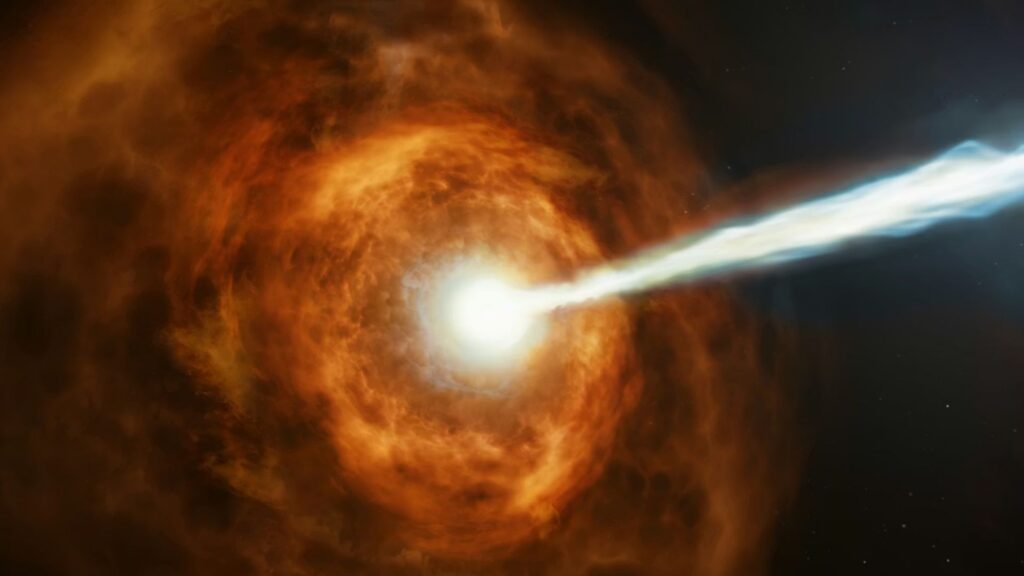
Neither of the two established origins for gamma-ray bursts—the collapse of a massive star or the merger of two neutron stars—can produce jets lasting seven hours. That’s what makes GRB 250702B such a puzzle, and why researchers have proposed something far more unusual. The leading explanation among Neights and her team is what scientists call a helium merger: a stellar-mass black hole, roughly three times the mass of the Sun, spiraling into and consuming a companion helium star from the inside out.
Under this model, the companion star has already lost its outer hydrogen layers, leaving behind a dense helium core. As the black hole’s orbit tightens, it moves into the body of the star and begins consuming it rapidly. All of that angular momentum feeds into the black hole, generating a long-lived jet. The model also predicts a supernova as the black hole devours the star from within, though the enormous amounts of dust surrounding the host galaxy prevented even Webb from detecting it.
A second theory involves an intermediate-mass black hole, one weighing several thousand times the Sun’s mass, shredding a passing star through tidal forces, a scenario scientists call a tidal disruption event. The helium merger remains the leading explanation among the gamma-ray team, though neither has been ruled out. With the question still open, Neights is now preparing the Compton Spectrometer and Imager telescope, set for launch in 2027, to detect future long-duration bursts.