
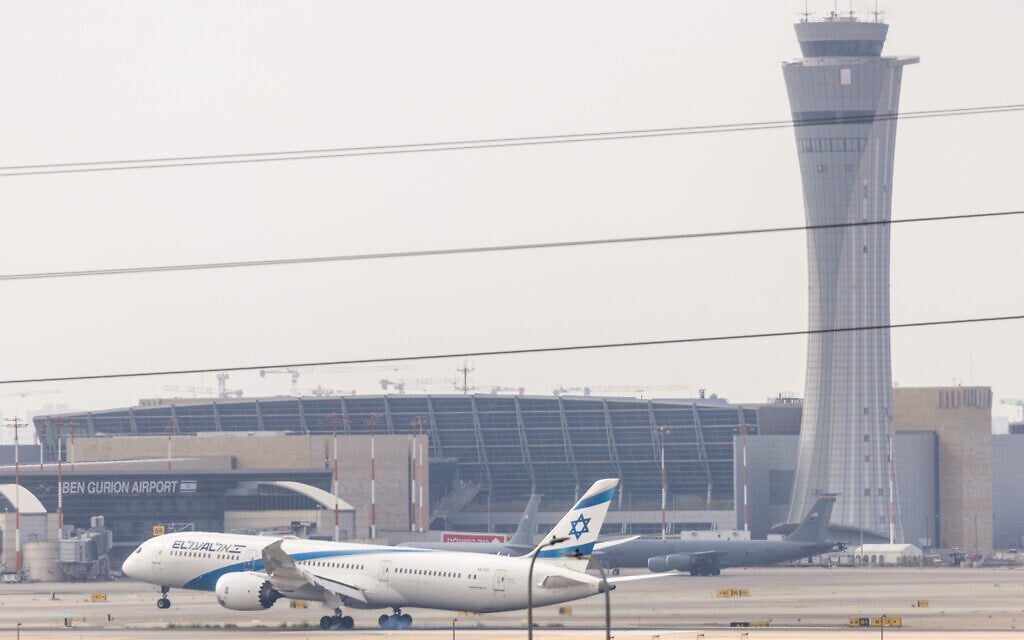
Israeli carriers cut Passover flights amid wartime restrictions
Impact on Passover Travel Due to Wartime Restrictions
As the Passover holiday approaches, travelers in Israel are facing significant disruptions due to ongoing wartime airspace restrictions. Major Israeli airlines, including El Al, Israir, and Arkia, have had to cancel the majority of their regular flights through at least the end of March. These cancellations are a direct result of the limited operations at Tel Aviv’s Ben Gurion Airport, which has been under strict security measures since February 28.
The current situation has forced local airlines to operate a restricted wartime flight schedule, focusing only on a limited number of destinations in the US, Europe, and the Far East. This means that many travelers are finding it difficult to plan their trips ahead of time, as the availability of flights is constantly changing based on the security situation.
Flight Cancellations and Adjustments
El Al and Israir have canceled their original flight schedules through March 27 and March 31, respectively. Arkia has also canceled its regular flight schedule through March 28. According to Mark Feldman, CEO of Ziontours Jerusalem, this has created a challenging environment for travelers.
“Passover travel will be a last-minute decision-making process, which may be impossible for people to understand, but that’s the reality in a war,” Feldman said. “Right now, a minimal amount of flights to a minimal amount of destinations are operated with the minimal amount of people permitted.”
Feldman added that Israeli airlines have canceled approximately 80% to 90% of their regular flight network. This drastic reduction in services has left many travelers scrambling to find alternative options.
Airspace Restrictions and Passenger Limits
The airspace over Israel has been largely closed to commercial traffic since the joint attacks with the US on the Iranian regime. Although Ben Gurion Airport has gradually reopened for limited inbound and outbound flights, these are operated solely by Israeli airlines such as El Al, Arkia, Israir, and Air Haifa.
Recent adjustments to passenger limits have further complicated travel plans. After slightly loosening restrictions, the Transportation Ministry tightened them again, limiting outbound wide-body flights to 130 passengers. This change followed an incident where three private jets were damaged by debris from an intercepted Iranian ballistic missile.
For wide-body aircraft used on long-haul flights, mainly to the US, this means that flights are departing with only half their usual capacity. Narrow-body aircraft, which can accommodate about 180 passengers, still have a limit of 120 passengers per flight. Inbound flights, however, are not subject to these passenger restrictions.
Adjusted Flight Schedules
El Al has announced a wartime schedule for flights between March 21 and 28, operating to 12 popular cities in the US, Europe, and Asia. These include New York, Miami, Los Angeles, Bangkok, Phuket, Tokyo, Paris, London, Milan, Madrid, Munich, and Athens. However, flights to Rome, Amsterdam, Lisbon, Geneva, and Warsaw are canceled next week due to operational restrictions.
Arkia will operate flights to Europe, the US, and the Far East during the period of March 22 to April 5. European destinations include Paris, Rome, London, Amsterdam, and Barcelona, with two weekly flights. Flights to Athens and Larnaca are also available. To the Far East, Arkia will operate flights to Bangkok and Hanoi.

Alternative Travel Options
With limited flight options, some travelers are turning to alternative routes. Feldman advised customers to consider traveling south to Taba Crossing and departing via land border crossings with Egypt or Jordan if they need to leave Israel quickly.
Arkia has prioritized re-accommodating customers whose flights were canceled, with tickets later being opened for sale to the general public. Israir has also adjusted its schedule, offering flights to destinations such as Athens, Budapest, Larnaca, Prague, Rome, Sofia, Tbilisi, Frankfurt, Berlin, Milan, and Bucharest in Europe, as well as Addis Ababa in Ethiopia. During the Passover holiday, additional destinations like Zanzibar and Kilimanjaro in Africa will be available.

Ongoing Challenges and Uncertainty
Despite these efforts, the situation remains unpredictable. Feldman emphasized that travelers cannot make plans more than 24 to 72 hours ahead, depending on the security situation and operational changes. With no alternatives to Israeli airlines, many are left waiting for updates on flight availability.
As the Passover holiday approaches, the uncertainty surrounding travel plans continues to impact both locals and tourists alike. The situation highlights the challenges of navigating air travel in a region affected by ongoing conflicts.