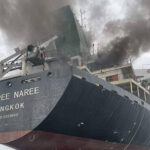

Oil Surges Past $112 as Iran Attacks Qatar Gas Hub
Escalation in the Middle East: Impact on Oil and Gas Markets
Following a series of attacks on energy facilities across the Middle East, tensions between Iran, the United States, and Israel have escalated significantly. This has led to a surge in oil prices, with Brent crude reaching a high of $112 per barrel on Thursday. The increase came after an earlier strike on the South Pars gas field, which is one of the world’s largest natural gas reserves.
Rising Oil Prices
Brent crude prices saw a significant jump, rising nearly 4% in the previous session and surpassing $112 per barrel. Meanwhile, West Texas Intermediate (WTI) crude is currently trading at its greatest discount to Brent crude in 11 years. WTI was last recorded at $96.67 per barrel, showing a 1.3% increase from the previous close.
The widening gap between WTI and Brent crude can be attributed to several factors. The release of oil from U.S. strategic reserves and increased freight costs are playing a key role in this price disparity. On the other hand, renewed assaults on Middle Eastern energy infrastructure have provided support for Brent crude prices.
Tensions Across the Middle East
QatarEnergy reported that Iranian missile attacks on Ras Laffan, a major location for Qatar’s liquefied natural gas (LNG) processing operations, caused widespread damage. Saudi Arabia also confirmed that it intercepted and destroyed four ballistic missiles launched toward Riyadh, as well as an attempted drone attack on a gas facility.
Before launching its attacks, Iran issued evacuation warnings for several oil facilities in Saudi Arabia, the UAE, and Qatar. This move was seen as a retaliation for strikes against its own energy infrastructure in South Pars and Asaluyeh.
South Pars is the Iranian part of the world’s largest natural gas field, shared with the U.S. ally Qatar across the Gulf. U.S. President Donald Trump claimed that Israel was responsible for the attack on the South Pars gas field, emphasizing that neither the United States nor Qatar had any involvement in the incident.
Trump also issued a warning, stating that Israel would refrain from future attacks on Iranian facilities in South Pars unless Iran launched an attack against Qatar. He further cautioned that the U.S. would retaliate if Iran took action against Doha.
Warren Patterson, head of commodities strategy at ING Group, expressed concerns about the potential for prolonged disruptions to Persian Gulf energy supplies. He noted that the move to strike Iranian energy assets is unusual, given the U.S. administration’s efforts to ease upward pressure on oil prices.
Turmoil in the Gas Market
Natural gas prices have also experienced a sharp increase, with the Dutch Title Transfer Facility natural gas prices reaching EUR 54.662. Iran’s retaliatory strikes against neighboring countries pose a greater risk to the gas market than any other commodity.
Ras Laffan Industrial City (RLIC) is a major hub spanning 295 square kilometers and housing refineries and petrochemical plants. Qatar utilizes this location to export 105 billion cubic meters (bcm) of liquefied natural gas (LNG), accounting for almost 20% of the world’s LNG trade.
However, the specific section of the RLIC that has been affected remains unknown. Patterson highlighted that damage to LNG facilities could lead to longer-term challenges for global gas markets, not just related to the resumption of flows through the Strait of Hormuz but also the time required for repairs at the sites.
Even if the LNG facilities remain largely untouched, the market will need to factor in a higher risk premium due to the growing threat to energy infrastructure in the region.
The South Pars gas field, responsible for approximately 70% of Iran’s total natural gas production, has been targeted among Iran’s energy assets. While the extent of the damage is still uncertain, this incident increases the risks to Iranian natural gas exports destined for Turkey, Iraq, and Armenia.
Iran supplies Turkey with approximately 8 billion cubic meters (bcm) of imports annually. Potential disruptions to these flows could force Turkey to seek alternative supply sources, possibly increasing reliance on Russia for additional pipeline gas.