What Ifs of History Start at Pearl Harbor
The Emotional Legacy of the USS Arizona
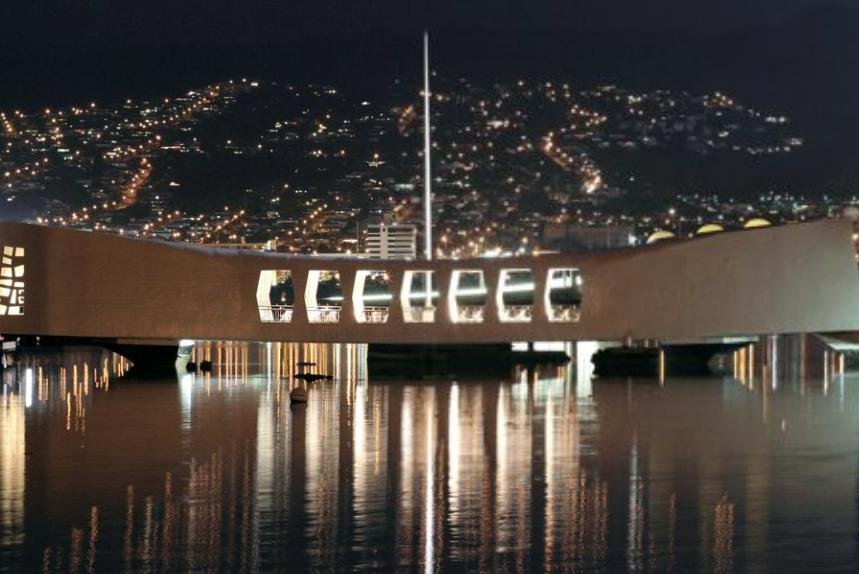
Visiting the watery grave of the Pennsylvania-class battleship USS Arizona in Pearl Harbor, Hawaii, is an experience that stirs deep emotions. The ship was struck by Japanese forces on December 7, 1941, during a surprise attack that left a profound mark on American history. Of the 1,177 sailors aboard the Arizona who lost their lives that day, approximately 1,100 remain entombed within the wreckage, along with Rear Adm. Isaac Kidd, the ship’s commander. The explosion of the Arizona’s forward magazine was a harrowing moment, symbolizing the chaos and devastation of that fateful morning.
Among the eight battleships damaged or sunk during the attack, only the Arizona and the USS Oklahoma did not return to service. This raises an intriguing question: what if Admiral Chuichi Nagumo, the Japanese commander, had made different strategic choices? For instance, what if he had waited for two of Pearl Harbor’s three aircraft carriers—USS Lexington and USS Enterprise—to return to port before launching his attack? Or what if he had targeted the fuel farms that supplied the U.S. Navy and its aviation gasoline? Additionally, what if he had focused on the submarines stationed at Naval Station Pearl Harbor?
These hypothetical scenarios could have drastically altered the course of World War II. If the Lexington and Enterprise had been destroyed instead of the battleships, the United States might not have been able to engage in the Battle of the Coral Sea six months later, which temporarily halted Japan’s expansion across the Pacific. Furthermore, without the Enterprise—the “Big E”—the decisive Battle of Midway, which shifted the war’s momentum, may never have occurred.
Despite these possibilities, none of these events took place. However, the question remains: what if they had? While Hitler’s declaration of war on the United States eventually brought America into the conflict alongside Britain, it is possible that the U.S. would still have emerged victorious through its industrial might, producing nearly 100 aircraft carriers and over 6,000 warships. But there is another “what if” to consider.
The Impact of September 11
The attack on September 11, 2001, marked another pivotal moment in history. When two hijacked planes crashed into the Twin Towers in New York, President George W. Bush declared a global war on terror. The search for Osama bin Laden, the mastermind behind the attacks, led to the invasion of Afghanistan. After the Taliban refused to hand over bin Laden, the U.S. launched Operation Enduring Freedom, which quickly dismantled Taliban rule with the help of the Northern Alliance and U.S. Special Forces.
However, bin Laden managed to escape to Tora Bora, a mountainous region bordering Pakistan. Despite a battle fought from December 15 to 17, 2001, he evaded capture. Poor planning by the U.S. played a role in this outcome. What if bin Laden had been killed or captured at Tora Bora? Would that have ended the global war on terror? And would the U.S. and NATO have embarked on a 20-year occupation of Afghanistan, ultimately leading to failure and chaos?
Additionally, would the U.S. have invaded Iraq, resulting in a costly and chaotic conflict that claimed countless lives? These questions remain unanswered, but they highlight the complex nature of historical events.
The Current Conflict and Future Implications
Today, the United States and Israel are engaged in what President Donald Trump has called an “excursion” into Iran. Suppose the U.S. had chosen not to join Israel in this conflict after it eliminated 40 of Iran’s senior leaders. In that case, the U.S. would not be at war in the Gulf, and the Strait of Hormuz would remain open. The Gulf states would also avoid the threat of Iranian missile and drone attacks.
It is too early to determine how this war will unfold. However, some analysts wonder if the conflicts in Afghanistan and Iraq are precursors to a similar outcome. If so, this war may not end satisfactorily.
Harlan Ullman, a senior adviser at the Atlantic Council and author of the doctrine of shock and awe, explores these themes in his upcoming book, Who Thinks Best Wins: How Decisive Strategic Thinking Will Prevent Global Chaos, co-written with Field Marshal The Lord David Richards. The book is set to be released in late 2026.