UAE Closes Airspace as Israel Strikes Lebanon and Tehran
Escalation of Conflict in the Middle East
Dubai, United Arab Emirates — Early Tuesday, explosions echoed over Dubai as the United Arab Emirates’ military worked to intercept incoming Iranian fire. This incident led to a brief closure of the UAE’s airspace, as Israel launched new strikes in the ongoing conflict in the Middle East.
The Israeli military announced that it had initiated a “wide-scale wave of strikes” across Iran’s capital and was also intensifying attacks on Iran-backed Hezbollah militants in Lebanon. This escalation came after Israel reported two incoming salvos from Iran. The situation has raised concerns about a potential global energy crisis, especially as only a small number of ships passed through the Strait of Hormuz, a critical waterway for global oil trade.
Impact on Global Energy Markets
Iranian attacks on commercial ships in and around the Strait of Hormuz have significantly slowed shipping, leading to a surge in oil prices. This has put pressure on Washington to take action to alleviate the strain on consumers and the global economy. Brent crude, the international benchmark, remained above $100 per barrel. U.S. President Donald Trump had previously demanded that several countries send warships to keep the Strait of Hormuz open, but his calls did not yield immediate commitments.
Iranian Foreign Minister Abbas Araghchi stated that the strait is “open” from Iran’s perspective, though not for the United States, Israel, or its allies. He also dismissed claims that Iran is seeking a negotiated end to the war as “delusional.”
Regional Tensions and Military Actions
Since the United States and Israel attacked Iran more than two weeks ago, Tehran has repeatedly fired drones and missiles at Israel, American bases in the region, and Gulf Arab countries’ energy infrastructure. The UAE shut down its airspace early Tuesday as its military responded to missile and drone threats from Iran. The closure was later lifted, with authorities stating that the situation had stabilized.
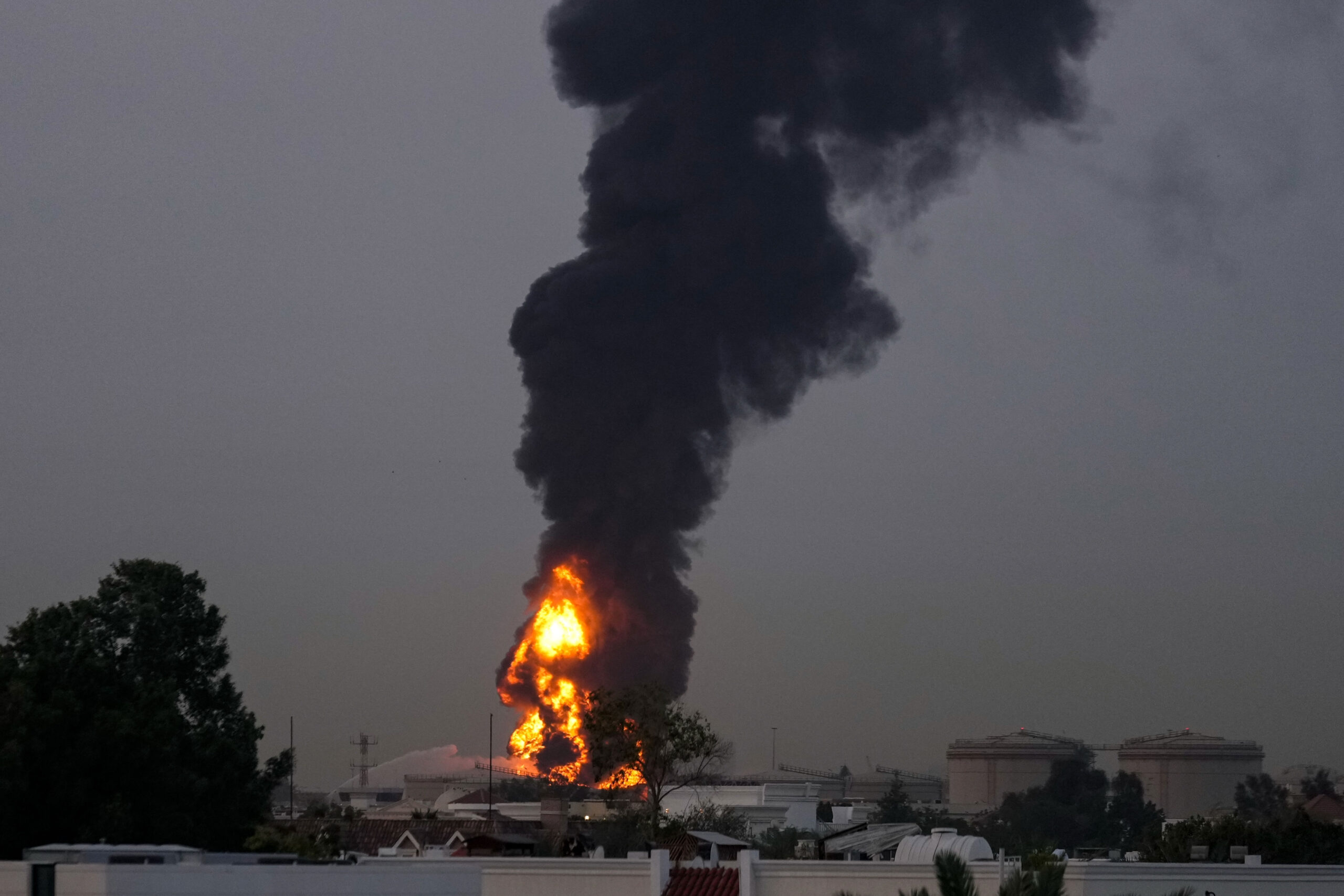
Shortly after, a missile warning alert was sent to people in Dubai, and the sound of explosions could be heard as the military worked to intercept incoming fire. A drone attack sparked a fire in an oil tank farm in Fujairah, a UAE emirate on the Gulf of Oman. No injuries were reported in the blast.
Challenges for the UAE
The snap announcement on its airspace highlighted the balancing act Emirati authorities face in maintaining their long-haul carriers, Emirates and Etihad, as Iranian attacks continue to target the country. On Monday, an Iranian drone attack set a fuel tank ablaze at Dubai International Airport, one of the world’s busiest for international travel.
Meanwhile, the Israeli military launched new attacks across Tehran and targeted Hezbollah militants in the Lebanese capital. Hezbollah began firing rockets into northern Israel after U.S.-Israeli attacks on Iran started on February 28. These actions have displaced over 1 million Lebanese, or roughly 20% of the population, according to the Lebanese government, which reports that some 850 people have been killed.
Human and Economic Toll
Israel has carried out approximately 7,600 strikes on Iran, knocking out 85% of its air defenses and 70% of its missile launchers, according to an Israeli military spokesman. In Israel, 12 people have been killed by Iranian missile fire, and at least 13 U.S. military members have lost their lives.
The virtual shutdown of the Strait of Hormuz has caused significant economic anxiety, driving up energy prices, threatening food shortages in poor countries, and complicating efforts by central banks to lower consumer prices.
International Responses
On Monday, Trump claimed that “numerous countries” had told him they were “on the way” to help police the Strait of Hormuz. However, he also criticized some countries for their reluctance, suggesting a lack of reciprocity in defense agreements with the United States.
Europeans have expressed criticism of the U.S. and Israel for not providing clarity on their objectives in the war. Trump emphasized the importance of enthusiasm among allies, though he did not specify which countries.
Brent crude fell to $100.21 per barrel on Monday, but remained up roughly 40% since the war began. Officials are working to ease prices, with Fatih Birol, head of the International Energy Agency, noting that member countries still have additional reserves of 1.4 billion barrels beyond the 400 million released last week.
Strategic Efforts and Diplomatic Moves
Adm. Brad Cooper, the top U.S. military commander in the Middle East, stated in a video posted on X that American forces are focusing on Iran’s threats to freighters carrying oil and natural gas. Ahead of a meeting in Brussels, the European Union’s foreign policy chief Kaja Kallas mentioned the possibility of extending a naval mission protecting ships in the Red Sea to the Strait of Hormuz.
Italian Foreign Minister Antonio Tajani expressed support for strengthening anti-piracy and defensive missions in the Red Sea but opposed expanding their role in the Strait of Hormuz. British Prime Minister Keir Starmer said Britain and allies are working on a plan to reopen the strait, with possible deployment of mine-hunting U.K. drones already in the region.
Japan and Australia indicated they have not been asked to assist in protecting the strait and have no current plans to do so. A person was killed in the capital of the United Arab Emirates when an Iranian missile hit a vehicle, and drone strikes caused fires at two UAE oil facilities in Abu Dhabi and Fujairah.